Imagines
[This web application should not be cited, since it is at present hosted on a staging site, but will soon find a permanent home.]
PROJECT NAME: Imagines
Project Director: Christopher Johanson, UCLA Classics, DH2, & DataX.
Lead Programmer: Benjamin Niedzielski
NAVIGATION:
Mouse-wheel or trackpad to pan and zoom (two-fingers).
Mouseover for information concerning specific person.
Highlight assemblage by person or by family name.
Models available are conservative, aggressive, and hyper-aggressive.
OVERVIEW:
Imagines is a single-purpose web application that visualizes hypothetical reconstructions of assemblages of Roman imagines, the waxen "masks" made into the likeness of high-status Romans in political or martial arenas. The imagines were stored in cabinets within Roman aristocratic homes, but were removed to be paraded in procession during aristocratic funerals.
This visualization depicts the imagines present in all known families in the Roman Republic at the time of death of a male member of the family who might have merited an imago.
The project extracts person information from the RDF server of the DPRR using SPARQL queries to create, in effect, its own ad hoc network graph, but also relies on the internal IDs to generate links back to entries in the DPRR, this each person visualized directly represents and links to supporting data.
MODELS (See below):
- Conservative represents family assemblages reconstructed according to evidence of kinship present in the DPRR. The DPRR only shows first and 2nd degree relationships.
- Aggressive expands to find possible ancestors by finding those who share the same nomen and cognomen of an appropriate age.
- Hyper-aggressive expands again to also find possible ancestors who only share the same nomen.
VISUALIZATIONS:
The assemblages are grouped into columns representing 25 year time periods.
The deceased appears on the left.
For the funeral event, these imagines were worn as masks by people who had also donned togas that would indicate the highest office or accomplished achieved by the deceased.
Praetor/Consul = Toga Praetexta = purple border
Triumphator = Toga Picta = Purple golden border
Censor = Toga Purpurea = Purple border
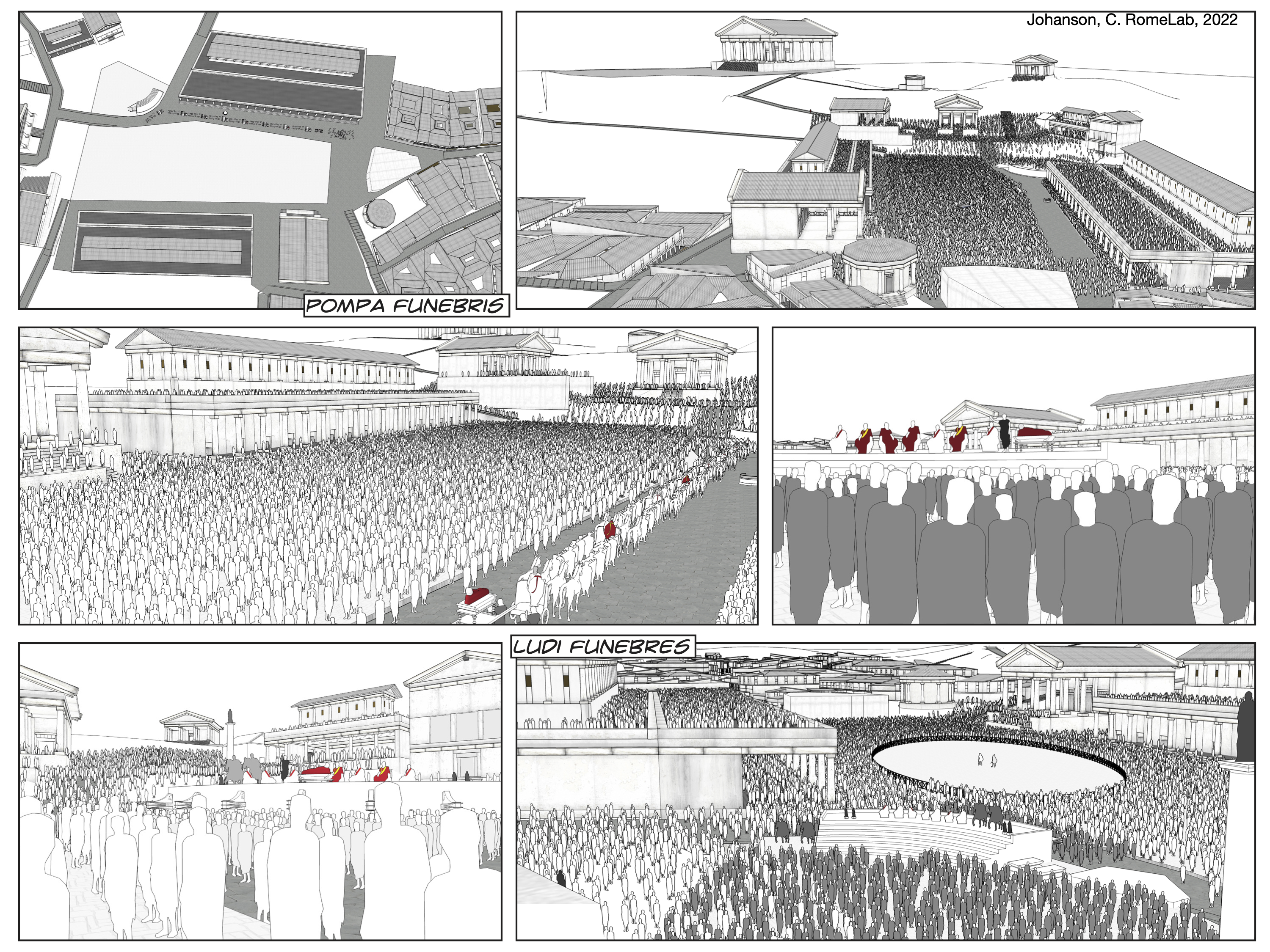
The Funeral event began with a procession to the Forum, where a funeral eulogy was given for the deceased, after which the ancestors on stage would also be praised. Following the eulogy, the body would be cremated or interred directly. At some funerals, gladiatorial games would also be held.
CODEBASE:
Codebase: https://github.com/dh-199-the-shape-of-roman-history/Roman-Funeral-and-Family/tree/master/Funerals_2022
Data Extraction and Processing
- Data extracted via SPARQL Query of RDF Server to produce .csv files:
- Name
- ID number
- Nomen/Cognomen
- Birth date/Death date
- Father/son relations with level of certainty
- Grandfather/grandson relations with level of certainty
- Highest obtained position
- List of people who have triumphed
Algorithm
- **Read the CSVs**
- **Build “Person” objects for each person in the CSV**
- Name
- ID number
- Nomen/Cognomen
- Birth/death dates
- Best position if it warrants a special toga (triumphator if they’ve triumphed)
- List containing IDs of relatives, relative type and if the relationship is secure
- This last step effectively forms a graph of people, with unidirectional links from son to father/grandfather.
- **Query user for which model to use (conservative, aggressive, hyperaggressive) and what output format to produce **
- **Sort people by death date**
- **For each person in the sorted list, recursively traverse the graph to generate text output containing the ID and best political position of each paternal ancestor, starting with the person and going to the oldest ancestor.**
- **Conservative:**
- Use only father/grandfather links in the database, preferring father where present.
- **Aggressive:**
- Use father/grandfather links in the database if present, preferring father where present.
- If not present, search for older people with the same nomen and cognomen, choosing the youngest who is at least 23 years older than the person in question.
- **Hyperaggressive:**
- Use links generated by conservative/aggressive where possible; if no link is present, search for older people with the same nomen, choosing the youngest who is at least 23 years older than the person in question.
Disclaimer
This web application is currently under development and hosted on a staging site. It will soon be available at a permanent location.